
How Machine Learning Can Reduce Battery Stress and Energy Use in EVs
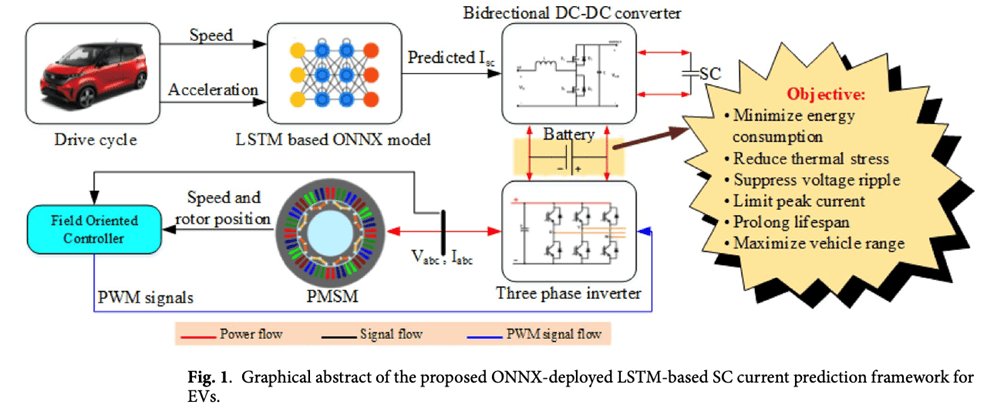
Image: Scientific Reports T. Paulraj & Yeddula Pedda Obulesu
Machine learning-based approach for reduction of energy consumption in hybrid energy storage electric vehicle.
Electrification is progressing rapidly — but the real-world challenge is not only how to power vehicles, it is also how to manage energy intelligently. Batteries remain the backbone of electric mobility, yet they are exposed to frequent high-power transients: aggressive acceleration, stop-and-go traffic, and regenerative braking spikes. These events drive peak current, heat, voltage ripple and long-term degradation.
A recent Scientific Reports study proposes a practical solution: hybrid energy storage combining a lithium-ion battery with a supercapacitor — coordinated by a machine learning-based control strategy that can run in real time.
The core idea: let the battery do “energy”, let the supercapacitor do “power”
Supercapacitors are highly effective for short bursts of power. In a hybrid energy storage system (HESS), the battery provides steady energy, while the supercapacitor buffers fast transients — both during acceleration and regenerative braking. The key challenge is energy management: deciding how much current the supercapacitor should supply or absorb at each moment.
The study introduces an approach that generates the supercapacitor reference current using a Long Short-Term Memory (LSTM) neural network trained on drive-cycle data (speed and acceleration). The trained model is exported into ONNX format and integrated into MATLAB/Simulink via an ONNX Predict block for real-time execution in a control loop. This is important: many AI-based strategies remain “paper-only” due to deployment complexity — ONNX integration directly addresses that gap.
What was tested
The authors model an EV powertrain based on the Nissan Sakura EV in Simscape and compare:
- A battery-electric configuration (BEV)
- A hybrid battery + supercapacitor configuration (HBEV), using the proposed LSTM+ONNX control
Performance is evaluated on two standard drive cycles:
- EUDC (mixed urban/highway dynamics)
- IM240 (highly transient, stop-and-go style dynamics)
Quantified results: less peak stress, less energy consumption
The reported improvements are substantial and consistent with what hybrid energy storage is designed to do:
EUDC cycle:
- Battery peak current reduced by 21.3%
- Peak battery power reduced by 18.1%
- Battery energy consumption reduced by 5.75%
IM240 cycle:
- Battery peak current reduced by 33.5%
- Peak battery power reduced by 31.6%
- Battery energy consumption reduced by 12.36%
The paper also reports improvements in battery voltage ripple and battery temperature, reflecting reduced electrical and thermal stress when the supercapacitor absorbs transient power exchange.
Why this matters for real-world decarbonisation
For fleets and consumers, EV performance is not just about maximum range under ideal conditions. It is about:
- Efficiency in real duty cycles
- Battery lifetime and thermal robustness
- Stable power delivery and drivability
Hybrid energy storage is a practical, technology-neutral lever that can improve EV operation today — and machine-learning-based control can make it adaptive without fragile, hand-tuned rule sets. The study explicitly positions the contribution as bridging research gaps around real-time feasibility, Simulink integration, and the combined evaluation of electrical + thermal impacts.
Hybrid Alliance takeaway
The energy transition will not be driven by one component alone. It will be driven by system-level engineering:
- Better power electronics
- Smarter control strategies
- Hybrid architectures that reduce stress and improve efficiency
This research underlines a key point: hybrid solutions exist inside EVs as well — and they can meaningfully improve performance and energy use under dynamic, real-world conditions.
Read more – source: Machine learning-based approach for reduction of energy consumption in hybrid energy storage electric vehicle | Scientific Reports